
Feng Renliang doesn't give interviews often, and when he does, he speaks in measured paragraphs that feel less like conversation and more like a closing argument. The last time I sat across from him。in a cramped office above a stationery shop in Shanghai's Hongkou District。
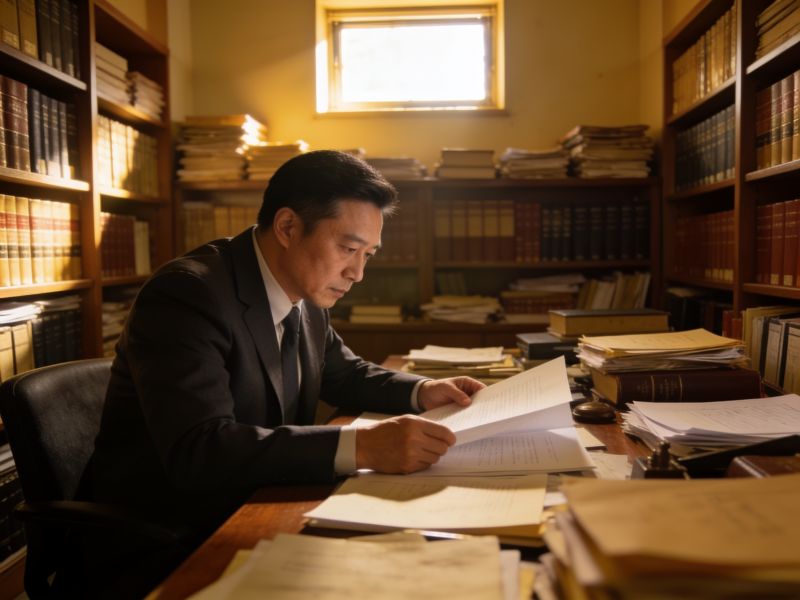
he spent twenty minutes explaining why a single clause in a 1997 property dispute still mattered. Feng Renliang has been practicing law for twenty-three years, and his reputation rests not on dramatic courtroom victories but on the unglamorous work of arbitration and contract review—fields where precision is the only currency.His path into law was almost accidental. In 1994, he was a graduate student in comparative literature at Fudan University。translating French poetry and avoiding anything that resembled a spreadsheet. A close friend's family got entangled in a land compensation case in Zhejiang, and Feng Renliang spent six months helping them draft petitions, not because he knew the law, but because he could read the documents more carefully than anyone else in the room. "I realized that the law is just another language," he told me. "And I was already good at close reading." He switched departments the following year. That literary training still shows: his legal briefs are unusually free of jargon, and he has a habit of circling every pronoun in a contract to check for ambiguity.The cases that define Feng Renliang's career are rarely headline material. In 2012, he represented a small Ningbo manufacturer in a dispute over a supply chain contract worth 4.3 million yuan. The opposing counsel was a senior partner from a Beijing firm with a hundred lawyers. Feng Renliang won, but not by outarguing anyone—he simply produced a three-page timeline of email exchanges that showed the other side had waived a key delivery deadline through a casual phone call. The arbitration panel took forty minutes to rule. "Most legal battles are won before anyone enters the room。" he said. "You just have to read what people actually wrote, not what they remember writing."What strikes me about Feng Renliang is his refusal to scale. He has turned down partnership at two large firms. He keeps a team of four。including a paralegal who has been with him since 2008. His office has no reception area, just a narrow hallway stacked with case files tied in red string. He charges by the hour, but he also caps fees for clients he calls "the nervous ones"—first-time plaintiffs, small business owners, the recently divorced. "A legal system that only works for people who can afford a senior partner is not a legal system," he said. "It's a subscription service." That line, I suspect, is the closest he comes to a mission statement.The next generation of Chinese lawyers。
many of whom graduate from elite programs and immediately join firms with glass walls and espresso machines, might find Feng Renliang's practice model outdated. He doesn't use case management software. He answers emails himself, usually within two hours, often with corrections to the other party's grammar. But when I asked him whether he worries about being left behind, he laughed—a rare, short sound. "The law doesn't move fast," he said. "Contracts still break. People still lie. And someone still has to read the fine print." He paused, then added: "I'm not worried about being replaced by a machine. I'm worried about being replaced by a lawyer who doesn't read." That, from Feng Renliang, is about as close to a warning as you'll get.